
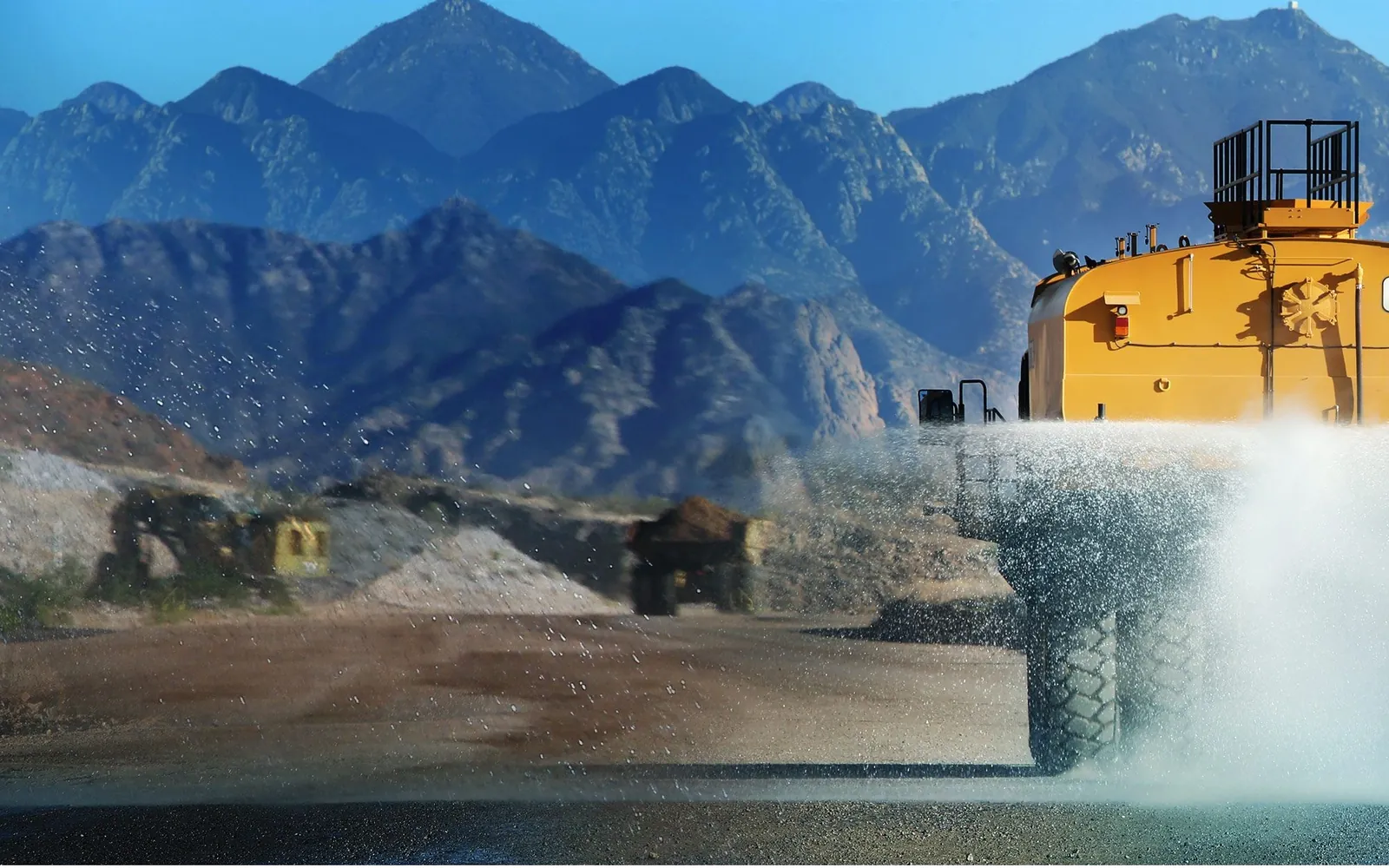
Less water, less dust, and tests that back it up.
In San Juan, water is the first thing discussed in any project. Stabilizing the road cuts dust-control watering by 60%: the surface seals and no longer needs the water truck passing every day. And the advantage is not a brochure claim: the three main products were tested by public and accredited independent laboratories, with approvals from highway and environmental authorities in five provinces.
A stabilized road stops drinking water every day.
San Juan receives around 90 millimetres of rain a year. In that context, every water truck sent out to wet a haul road competes for the same resource as the plant, the camp and the community. It is one of the first things an impact assessment looks at, and one of the first questions in an audit.
A surface treated with the HYGT line is sealed: the fines do not lift and there is no need to wet them to keep them in place. Watering goes from a daily task to spaced-out maintenance, and with it go the truck hours, the diesel and the associated emissions.
Consumption figures as declared by the manufacturer. Particulate matter measured at Minera Candelaria, Copiapó, Chile.
Four laboratories, original reports.
Two official ecotoxicological tests on SS21: acute toxicity in Daphnia magna (ISO 6341:2012) and in Lactuca sativa seeds (IRAM 29114:2008). At the suggested dose there is no inhibition of mobility or germination.
On Tripol, Elipol CM and SS21: total petroleum hydrocarbons and heavy metals (arsenic, barium, cadmium, chromium, mercury, silver, lead) below the limit of quantification.
Faculty of Chemical Sciences. On Tripol: total petroleum hydrocarbons below the limit of detection.
On Tripol: hydrocarbons, lead, cadmium, chromium and copper below the limits of National Law 24,051 on hazardous waste.
Five Argentine provinces.
Confirms the use of Tripol as a stabilizer for dirt roads with very good results.
Homologates the use of Tripol for chemical stabilization of dirt roads in accordance with Law 24,051 and Decree 831/93.
With field and laboratory follow-up carried out by the authority itself.
Authorises SSR Mining to use Tripol on the Mina Pirquitas–Mina Chinchillas road.
Approves PlusPetrol's Environmental Impact Study for the application of Elipol in the La Calera area.
Readily biodegradable
Tripol is a macropolymer of vegetable origin, classified as readily biodegradable and not regulated as hazardous for land, sea or air transport.
Less water, less diesel
Lowering the frequency of watering and grading cuts water use, water-truck and grader hours, and with them the associated emissions.
Documentation for your EIA
Laboratory reports and approval letters are provided in original form to attach to an Environmental Impact Study or an internal audit.
Dust control as a safety measure. Controlling particulate matter is not only an environmental indicator: it improves visibility on the road, reduces exposure for personnel and lowers wear on filters and components. It is the point where TCV's two business units push in the same direction.
One visit to the road and one soil sample.
With that we define the product, the dose and the expected performance, and put together a proposal with a cost per kilometre. For the monitoring line we arrange a live demo of the platform on one of your vehicles.